
Every quarter, a share of New Zealand property owners sell for less than they paid. In a strong market it is a small share. In a soft one it climbs above one in eight. The share moves with the cycle. The reason people end up in that group barely moves at all.
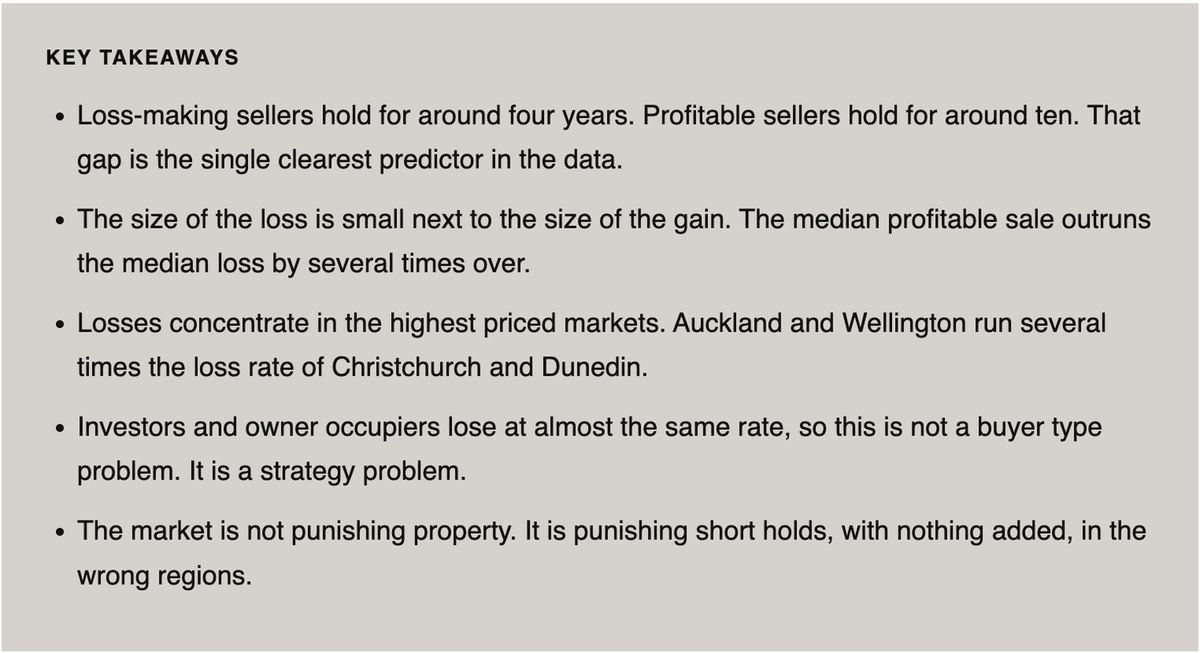
Sellers who lose money hold for a short time, in the regions that fall hardest, on properties they never improved. Sellers who make money hold for roughly twice as long. That pattern shows up in every edition of the data, in every market, and it is the most useful thing an investor can know before they buy.
What the data on loss-making sales shows
Cotality's Pain and Gain report tracks every residential resale in New Zealand and compares the sale price against what the seller originally paid. It is published quarterly, and the shape of the finding repeats.
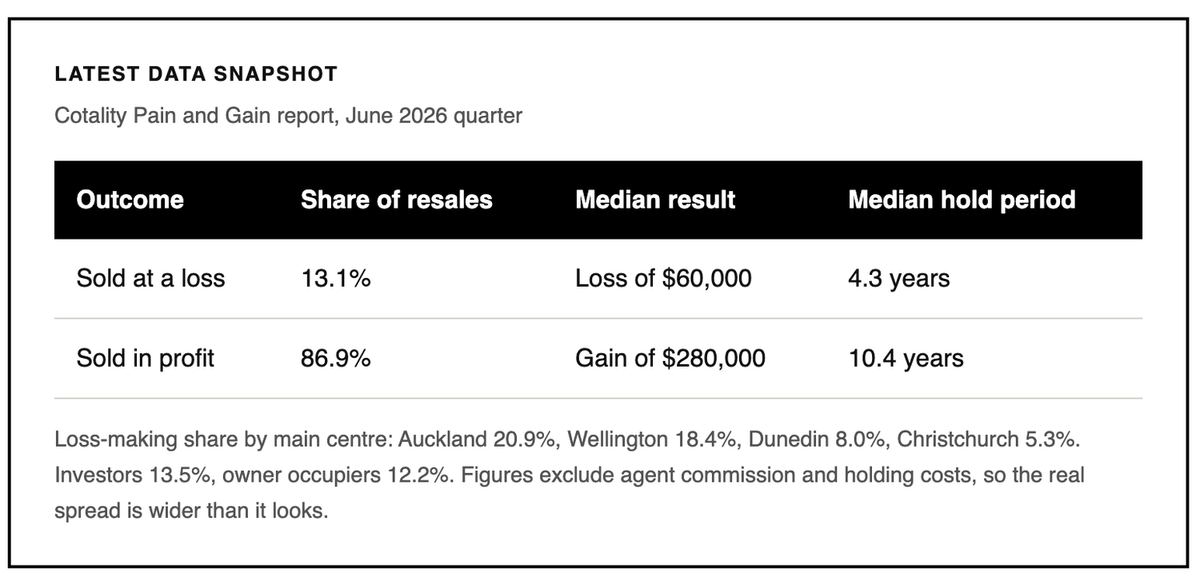
In this particular quarter the loss-making share was the highest since 2012, driven by owners who bought near the peak and sold about four years later. In a stronger quarter that share drops into the low single digits. What does not change is who sits in the loss column: the short holders, in the expensive markets, who bought at retail and changed nothing.
Why do property investors sell at a loss?
Investors sell at a loss when something forces the sale before the property has had time to grow, and they have no equity buffer to absorb the gap. Three factors do almost all the damage.
1. They held for a short time
Four years is not a property cycle. It is a snapshot of one. Sellers who make money have typically held long enough for at least one full cycle to run, which is why their median hold period sits at roughly twice the loss-making group.
2. They bought in the markets that fall hardest
Higher priced markets fall further and recover more slowly. Auckland and Wellington consistently post the highest share of loss-making resales, while Christchurch and Dunedin stay low through the same national conditions. Same country, results several times apart.
3. They had nothing to sell but the market
If a property is bought at retail price and left exactly as it was found, the only thing that can lift its value is the market. When the market pauses, the owner has no other lever to pull.
Notice what is not on that list. Interest rates are not on it. Government policy is not on it. Those things change the weather, but they do not decide who gets caught out in it.
Every loss-making sale is someone who did not get to choose their timing. Something forced it. A rate rise, a job change, a tenancy gone wrong, a mortgage that never quite covered itself.
Nobody sells a good property that pays for itself into a soft market by choice. They sell because the property was costing them money every week and the market gave them a reason to stop the bleeding.
That is the actual risk in property, and it has nothing to do with predicting the next twelve months.
How long do you need to hold a property in New Zealand to make a profit?
There is no fixed number of years, but the data is consistent: sellers who make a profit have typically owned the property for around ten years, while sellers who make a loss have owned theirs for around four.
The more useful way to read that is not as a target but as a warning. Ten years is easy if the property pays for itself. Four years is unbearable if it does not.
So the question is not "how long should I hold". It is "what would make me sell early", and then removing those things one by one before you buy.
Two buffers that stop a forced sale
You cannot control the short term market. You can control whether the property pays for itself while the cycle does its thing. Two buffers do the heavy lifting.
1. Create cashflow positive properties
A property that produces surplus income from day one is not a monthly cost, it is a monthly contribution. It can sit through a flat market for as long as it needs to, because nothing about holding it hurts. That is what turns a sale date into a choice rather than an emergency.
Cashflow is bought at purchase, not hoped for later. It comes from what you pay, what configuration you buy, and what the property can rent for once it is working properly.
2. Add value to manufacture equity
Buying below market value and renovating deliberately creates equity that does not depend on the market moving. It gives you a margin between what you owe and what the property is worth, so a soft market eats into a buffer instead of eating into you.
Add value also lifts the rent, which feeds straight back into the first buffer. The two compound.
A property with both buffers doesn’t need to be sold in a soft market. You sell when the market is right for you.
The Takeaway
Whether a sale makes money or loses it is decided long before the listing goes up. It is decided by what you paid, what you bought, and whether the property could carry itself while the cycle did what cycles do. Get that right and a soft market is something you sit through. Get it wrong and it is something that happens to you.
That is exactly the work we do alongside our clients. Buying below market value, manufacturing equity through renovation, and building cashflow in from day one. Having Wolfe Property in your corner means you are not guessing at the numbers or finding the problems after settlement. It means you buy properties you won’t be forced to sell.
Don't let the wrong strategy leave you in the dust. We’re here to help.
Data source: Cotality Pain and Gain report, June 2026 quarter. Last updated August 2026. This article is general information and not personalised financial advice.