
How One NZ Investor Turned a Distressed Duplex Into $170,000 Net Profit (And What It Teaches Us About Property Investing in 2026)
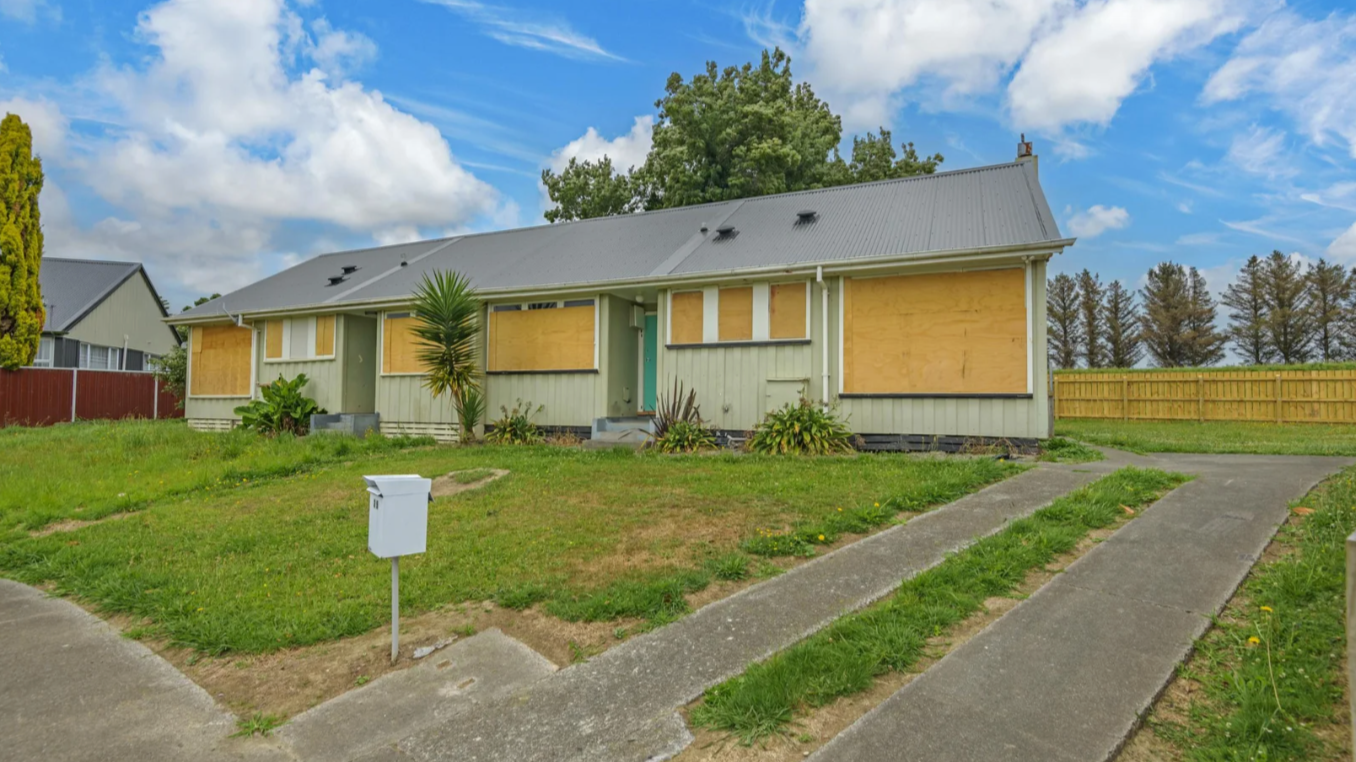
Most investors scrolled past this listing.
Two dwellings on one title. Dual income potential. High rental demand area. On paper, it ticked every box.
Then they walked through it.
Boarded-up windows. No hot water cylinders. Wiring stripped out. Bare shell interiors. Within minutes, most buyers were back in their cars and already on to the next listing.
But one investor a (Wolfe Property client) saw something different.
And the result was $170,000 in net profit, $1,040 a week in rental income, and an 11.3% gross yield on total project cost.
This is the full breakdown of how that deal was found, analysed, and won.
The Property Most Investors Walked Away From
The duplex was launched through a full marketing campaign and went to a multi-offer deadline sale. In the current NZ market, dual-income properties are highly sought after. Investors know that two income streams on one title means stronger cashflow, better yield, and more resilience against vacancy.
So when this one hit the market, it attracted immediate attention.
Then buyers walked through it.
The property had been stripped back almost entirely:
No hot water cylinders
Wiring removed throughout
Boarded-up windows
Bare shell interiors
Completely rundown presentation
To most buyers, it looked like a disaster. The kind of property banks hesitate on. The kind most investors assume is simply too risky.
Conditional offers started coming in. Finance clauses. Builder's reports. Long due diligence periods.
And one by one, buyers started pulling back.
The Detail That Changed the Entire Risk Profile
Among all the chaos inside that property, there was one significant positive that most buyers missed entirely.
The property had recently received a brand-new roof.
That single detail changed everything.
Because while the cosmetic condition was genuinely terrible, the structural integrity of the building was still intact. The new roof meant the project shifted from an unknown structural risk into a highly predictable renovation exercise:
Rewire
Refit
Reline
Cosmetic transformation
Rental optimisation
And critically, because the structural wildcard had been removed, the numbers could now be modelled with real confidence.
This is one of the most important lessons in property investing: the difference between a deal that is risky and a deal that merely looks risky. Fear is often a function of appearance, not fundamentals.
How Our Client Won a Competitive Multi-Offer Campaign
In a deadline sale with multiple buyers, conditional offers rarely win. The vendor wants certainty, and a conditional offer no matter how attractive the price introduces uncertainty.
Our client knew this. So rather than competing on conditions, they competed on certainty.
They went in with a cash unconditional offer.
But here is what made that possible: they had done their homework before the offer was ever made. Not after. Before.
The due diligence completed upfront included:
As-is registered valuation - establishing current market value at $270,000
As-if-complete registered valuation - establishing projected end value at $650,000
Detailed renovation scope and costings - $180,000 budget confirmed
Rental appraisals for both completed dwellings - $520 per week per dwelling
This is not recklessness. This is preparation. And it is the difference between an unconditional offer made in confidence versus one made in hope.
The Numbers That Made This Deal Work
Dream it
- Purchase price $300,000 - Registered valuation (as-is) $270,000 - Renovation budget $180,000 - Total project cost $480,000 - Projected end value $650,000 - Net profit $170,000 -
Dream it - Purchase price $300,000 - Registered valuation (as-is) $270,000 - Renovation budget $180,000 - Total project cost $480,000 - Projected end value $650,000 - Net profit $170,000 -
It is worth noting that our client paid $30,000 above the registered valuation. That might sound counterintuitive… but they were not buying based on what the property looked like today.
They were buying based on future value, future rent, and the scarcity of dual-income properties in that area.
When you have validated the numbers before you make the offer, paying above today's valuation is not a risk. It is a calculated decision.
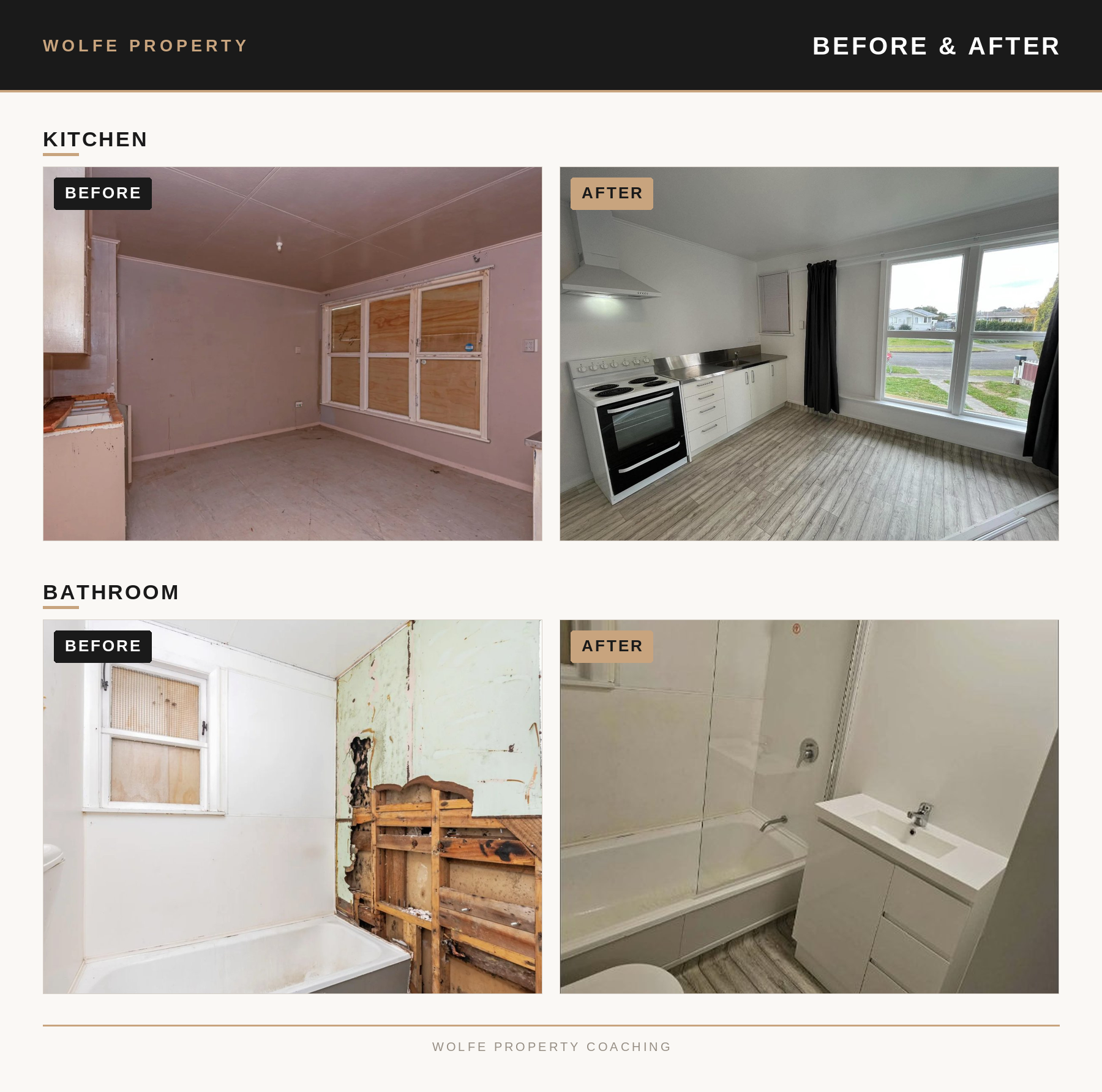
The Cashflow and Yield
At purchase, the property was completely untenanted. No rental income at all.
Post-renovation, both dwellings are projected to return:
$520 per week per dwelling
$1,040 per week combined
$54,080 per year in gross rental income
On a total project cost of $480,000, that gives a gross yield of 11.3%.
For context, gross yields in most NZ regional centres currently sit between 5% and 7%, with the highest-yielding markets reaching 6 to 8% in areas like Invercargill and Dunedin.
An 11.3% gross yield on a renovated duplex in a high-demand area is a strong result by any measure.
What This Deal Teaches Us About Investing in the Current Market
A lot of NZ investors are sitting on the sidelines right now. Interest rates have been elevated. Values have shifted. The news cycle makes it hard to feel confident about making a move.
That hesitation is understandable. But it is also creating opportunity.
Here is what we are seeing on the ground:
Investors are losing deals over $10,000. An extra $10k on an interest-only mortgage is the cost of roughly one coffee a week in interest. In ten years, you will not remember whether you paid $420,000 or $430,000. You will remember whether you bought the property or not. If the numbers work, the numbers work.
Too many buyers are relying on CVs and online estimates. CVs and homes.co.nz figures are algorithms. They were never designed to value individual properties for purchase decisions, and they certainly cannot account for interior condition or renovation potential. The only professional whose opinion matters here is a registered valuer. And the smart move the move this client made is to get both an as-is and as-if-complete valuation before going unconditional.
There is no perfect time to buy. There will always be headwinds. There will always be tailwinds. The market does not reward perfect timing. It rewards action when the numbers work. If you have run the analysis, stress-tested the deal, and it stacks that is your green light. The investors building real portfolios are not the ones who timed the market perfectly. They are the ones who did the analysis, trusted the method, and acted.
The Bigger Lesson: Preparation Beats Hesitation Every Time
Most people who walked through this duplex saw a liability. Our client saw a mathematically predictable value-add opportunity.
The difference was not luck. It was not experience for its own sake. It was preparation.
They reduced uncertainty by:
Paying for professional reports before the offer
Understanding the renovation scope in detail
Validating end values through a registered valuer
Confirming future rental income through a property manager
Acting decisively when the opportunity appeared
While other buyers were scared off by how ugly the property looked, our client focused on what it could become.
That mindset and the process behind it is what turned a distressed shell into a project with strong dual income, significant net profit, double-digit gross yield, and long-term investment upside.
What the Wolfe Property Process Looks Like in Practice
This case study is not unusual for our clients. It is the result of a repeatable process that we teach inside our coaching programmes.
The Cashflow Hacking framework is built around finding properties that others overlook, running the numbers correctly, and acting with confidence when the opportunity is there.

If you are an NZ investor looking to build a portfolio that genuinely performs - whether that is through manufactured equity, dual income, or cashflow hacking strategies - we would love to talk.
Book a no-obligation call with the team
